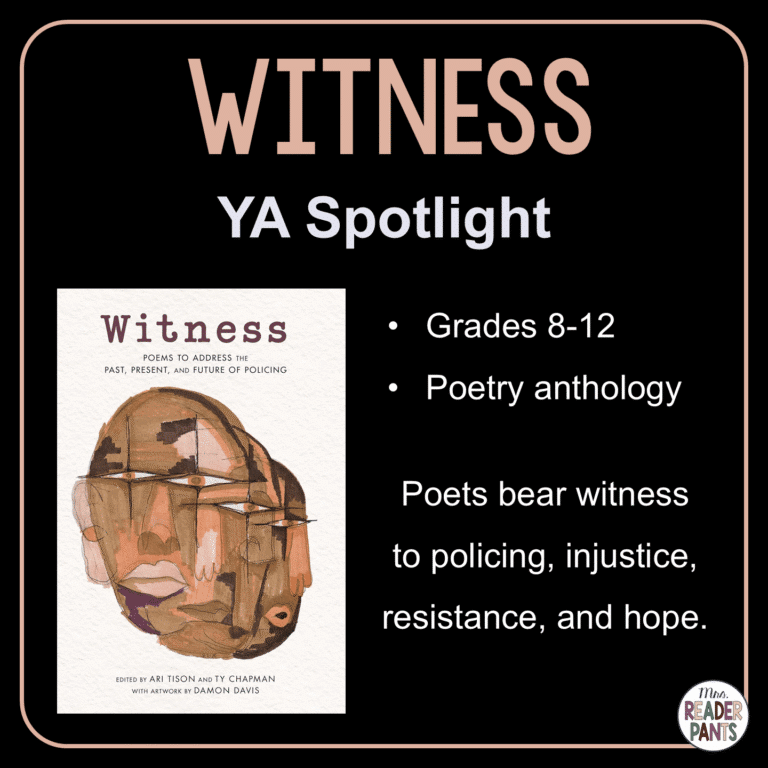
Witness: Poems to Address the Past, Present, and Future of Policing, edited by Ty Chapman and Ari Tison, brings together 38 poems examining policing in America. Written for teens and adults, this challenging anthology received starred reviews from Kirkus and School Library Journal.
Author: Ari Tison and Ty Chapman, eds.
Illustrator: Damon Davis
Genre: poetry anthology
Setting: multiple USA locations and time periods
Themes: over-policing, police violence, public safety, racism, discrimination, prejudice, social injustice, civil rights, racial profiling, homelessness, slavery, immigration enforcement, George Floyd, the Uvalde school shooting, the ICE shooting of Renée Good, protest, resistance, grief, hope
Recommended for: Grades 8-12
Starred reviews: Kirkus and SLJ
Notes: Includes 38 poems by multiple contemporary writers. Features paper, paint, and ink artwork and black-and-white photographs.
Publication date: September 1, 2026

WHAT IT’S ABOUT
Written by a diverse group of contemporary poets, the collection explores policing across history, the present day, and imagined futures. Its contributors address racial profiling, surveillance, deportation, displacement, homelessness, school shootings, and deaths caused by police violence.
Several poems commemorate specific people and events. For example, Bao Phi’s “8 (9)” remembers Fong Lee, a 19-year-old Hmong American killed by Minneapolis police in 2006. The title “8 (9)” refers to the shooting: eight bullets struck Lee, while a ninth missed him. The poem has nine stanzas, reflecting those nine shots. It also addresses the wider history of police violence against people of color and names other victims.
K. A. Holt’s haunting “Uvalde Villan-elle” uses the repetitive structure of a villanelle to confront law enforcement’s devastating failures during the May 24, 2022, shooting at Robb Elementary School. Nineteen children and two teachers were killed while officers waited more than an hour to confront the gunman.
Other selections approach policing through personal or family experiences. Laura Ruby writes about her Jewish father’s career as a police officer, while W. J. Lofton considers the inequalities endured by someone he loves.
The collection also reaches further into the past, including Kauakanilehua Māhoe Adams’ examination of missionary colonization in Hawai‘i.
You can see the full list of contributing authors on the publisher’s website.
GRIEF, ANGER, AND IMAGINED FUTURES
These poems do not offer one perspective or a simple answer. Grief, fear, fury, exhaustion, tenderness, humor, resistance, and hope exist alongside one another. Some poets bear witness to injustice; others imagine forms of public safety grounded in community, care, and accountability. Junauda Petrus’ vision of a grandmother-run police department provides one of the anthology’s most memorable alternatives.
Imagination itself becomes a means of survival—and an invitation to envision something better.
ART THAT ALSO BEARS WITNESS
Damon Davis’ expressive paper, paint, and ink artwork adds another layer to the collection. Exaggerated figures, recurring sets of watchful eyes, abstractions, and documentary photographs create a visual conversation with the poems.
Contributor biographies, poem notes, and a further-reading section offer valuable context for discussion and study. Intense and sometimes unsettling, Witness is a powerful choice for mature teen poetry collections and classrooms exploring protest, justice, civic responsibility, and the role of art in creating social change.
YOU MIGHT ALSO LIKE