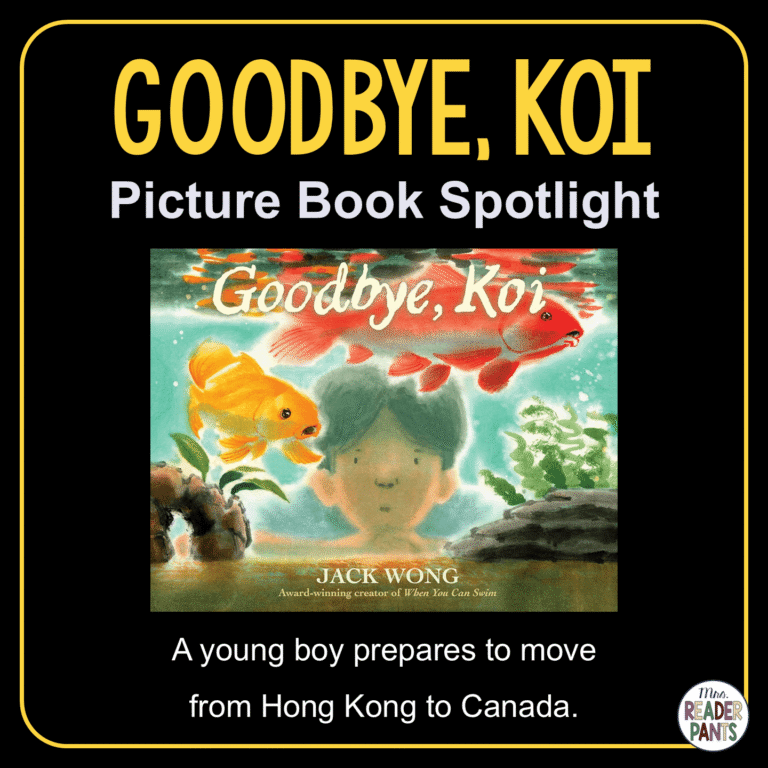
Goodbye, Koi by Jack Wong is a tender, visually striking picture book about leaving behind a beloved home and stepping into the unknown. Inspired by Wong’s childhood move from Hong Kong to Canada, this quiet story captures the sadness, uncertainty, and hope that accompany a major life transition.
Goodbye, Koi has been added to my September 2026 – New Release Spotlight list on Amazon.
Author and Illustrator: Jack Wong
Genre: picture book
Setting: moving from Hong Kong to Canada
Themes: moving to a new country, koi fish, saying goodbye, family, connection, based on a true story, fathers and sons, Chinese characters, home
Protagonist: young boy and his father, both East Asian
Recommended for: PreS-Grade 3
Starred reviews: Kirkus, Horn Book, and Publishers Weekly
Publication date: September 15, 2026

WHAT IT’S ABOUT
A young boy and his father are preparing to move far away, but first they must find a new home for the family’s koi fish. Together, they take the fish from their aquarium and release them into a large garden pond.
As the family completes errands, visits relatives, and packs for the journey, the boy’s thoughts remain with the koi. Will they like their new pond? Will they feel lonely? Will they remember their old home? His questions about the fish gently reflect his own unspoken worries about moving somewhere unfamiliar.
The boy’s father reassures his son, reminding him that the koi will adapt—and that their family will face its own new beginning together. After saying goodbye to the empty aquarium, father and son realize that they are finally ready to leave.
WHY IT STANDS OUT
I think my own sons would identify with the boy in Goodbye, Koi. When they were seven and nine years old, we moved from Fort Worth, Texas to Suzhou, China, to teach at an international school. The boys had to adapt to an entirely new country after saying goodbye to friends and family. We lived abroad for the next 11 years and only recently returned to Texas. Moving to China was exciting, but our return has brought its own mixture of excitement, uncertainty, and sadness—feelings this story captures beautifully.
Wong allows young readers to experience the family’s move gradually. Although the narrator focuses primarily on the koi, the illustrations reveal the larger story through packed boxes, donated clothing, family gatherings, suitcases, and a newly purchased winter coat. Observant readers may recognize that the child’s concern for the fish gives him a manageable way to process his own uncertainty.
The artwork is especially memorable. Wong combines watercolor, digital collage, and traditional Chinese brush-painting techniques, alternating detailed family scenes with fluid close-ups of brilliant red, yellow, and gold koi. Cultural details—including Hong Kong architecture, market scenes, and Chinese characters—add specificity and depth.
Three starred reviews—from Horn Book, Kirkus, and Publishers Weekly—affirm the emotional and artistic strength of this thoughtful picture book. Goodbye, Koi will resonate with children facing a move, immigration, separation from a pet, or another significant change. It offers an honest but comforting message: saying goodbye can be painful, but love, memory, and family can help us move forward.
MORE PICTURE BOOKS ABOUT HOME