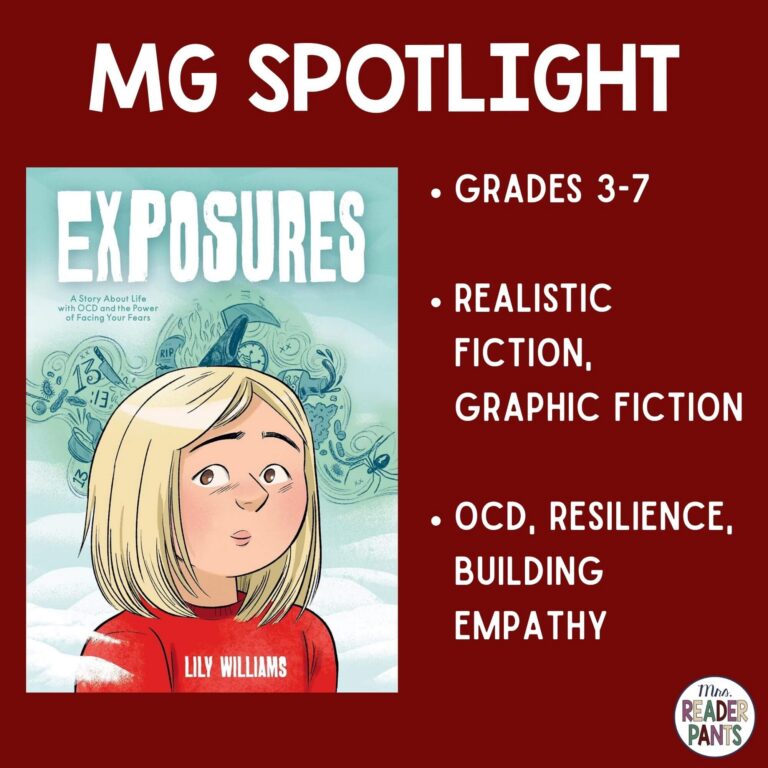

Three starred reviews caught my attention, but the deeply personal story behind Exposures makes this new middle grade graphic novel especially noteworthy. Drawing from her own experiences with OCD, Lily Williams offers an honest, compassionate look at intrusive thoughts, exposure therapy, and the courage it takes to face your fears.
Author and Illustrator: Lily Williams
Genre: graphic fiction, realistic fiction
Setting: fictional ski town in winter
Themes: Obsessive-Compulsive Disorder (OCD), intrusive thoughts, facing fears, courage, resilience, family, self-acceptance, healing, rediscovering joy, mental health, building empathy
Protagonist: female, age 12, white
Recommended for: Grades 3-7; SLJ recommends Grades 6+
Starred reviews: Booklist, Publishers Weekly, and Kirkus
Publication date: August 11, 2026

Twelve-year-old Peyton remembers when life felt easier. She loved dancing, baking, skiing, and spending time with her twin sister, Taylor. But over time, frightening thoughts and increasingly complicated rules have begun taking over her everyday life. Certain colors feel dangerous. Numbers carry meaning they shouldn’t. Cracks in the sidewalk need to be avoided. Riding the bus brings fears about germs, and even ordinary foods can suddenly seem unsafe.
In Exposures by Lily Williams, Peyton has spent years hiding just how much these fears control her. She develops rituals and avoidance behaviors meant to keep terrible things from happening to the people she loves. Of course, the rituals don’t actually make her family safer—but to Peyton, ignoring them can feel impossible.
Her fears increasingly interfere with the things she once enjoyed and strain her relationships with her family and friends. Peyton especially worries about Taylor, whose seemingly easier path through adolescence only highlights how much Peyton is struggling. Eventually, a severe panic attack reveals the extent of what Peyton has been experiencing, and her parents realize she needs more help than they can provide on their own.
Peyton begins working with a therapist, who helps her understand that what she is experiencing has a name: obsessive-compulsive disorder, or OCD. Her treatment includes Exposure and Response Prevention (ERP), a form of cognitive behavioral therapy that asks Peyton to gradually confront the things that trigger her fears without performing the compulsions she normally uses to make herself feel safe.
Williams does not portray therapy as a magical solution. Exposure therapy is uncomfortable, frightening, and sometimes downright miserable for Peyton. Something as seemingly simple as wearing a red sweater can unleash a flood of intrusive thoughts about blood, death, and the possibility of something terrible happening.
The goal isn’t to convince Peyton that nothing bad will ever happen. Instead, she must slowly learn to tolerate uncertainty without allowing her OCD to dictate what she does next. That distinction gives Exposures unusual depth. Peyton’s progress isn’t linear, either. She struggles, moves forward, has setbacks, and keeps working.
Along the way, her family also learns. OCD does not affect Peyton in isolation, and her parents and sister must figure out how to support her without reinforcing the compulsions and fears that are making her world smaller.
One of the greatest strengths of Exposures is how effectively the graphic novel format makes an often-invisible mental health condition visible. Williams uses changing fonts, speech balloons, panel layouts, color, and imagery to show readers how quickly an intrusive thought can escalate and overwhelm Peyton.
Color is particularly important. Red becomes one of Peyton’s major triggers, and Williams allows readers to experience how an ordinary color can become connected to an increasingly frightening chain of thoughts. The illustrations make it easier to understand why Peyton cannot simply “stop worrying” or recognize her fears as irrational and move on.
At the same time, the artwork keeps this emotionally challenging story accessible to middle grade readers. Exposures can be intense, but it is also warm, compassionate, and ultimately hopeful. Peyton is never reduced to a diagnosis. She remains a kid who loves her family, misses the activities she once enjoyed, and wants desperately to feel like herself again.
That balance may make the book especially meaningful for young readers who recognize parts of their own experiences in Peyton. For readers who do not have OCD, it offers an empathetic window into what living with intrusive thoughts and compulsions can actually feel like.
Exposures draws from Lily Williams’s own experiences with OCD, giving Peyton’s story an especially personal foundation. Williams approaches the subject with honesty while resisting the temptation to turn recovery into a simple inspirational narrative. Facing her fears requires genuine courage from Peyton, but courage does not mean that she stops being afraid. It means learning that fear does not always have to make her decisions.
Williams may already be familiar to graphic novel readers as the illustrator and co-author of Go With the Flow with Karen Schneemann, published in 2020. That middle grade/young teen graphic novel explores friendship, periods, activism, and menstrual equity. She is also the author and illustrator of the nonfiction picture book If Sharks Disappeared (2017), which explores the important role sharks play in maintaining healthy ocean ecosystems.
With Exposures, Williams turns that ability to make complicated subjects understandable toward a deeply personal topic. The result is a graphic novel about OCD, but it is also a story about family, identity, courage, and reclaiming the parts of yourself that fear has pushed aside.
Most importantly, Peyton’s story does not promise that confronting OCD makes every frightening thought disappear. Instead, Exposures offers something more believable—and perhaps more reassuring. Peyton learns that she can experience fear and uncertainty and still move forward. She can have setbacks and still be making progress. And little by little, she can begin returning to the things she loves.