Weaver and the Web by Chris Baker is one of those rare books that gives readers an appreciation of nature and it’s wondrous creatures. Told entirely from the perspective of a spotted orbweaver spider, this visually stunning informational picture book combines beautiful artwork, fascinating science, and a gentle message about resilience. Even readers who aren’t fans of spiders may come away with a new appreciation for these remarkable engineers.
This is an excellent choice for STEM units, nature studies, engineering, and discussions about perseverance. Could this be a Sibert 2027 contender? I’ve added it to my growing list of possibilities!
Author: Chris Baker
Illustrator: Byron Eggenschwiler
Genre: informational picture book
Themes: spiders, art in nature, everyday wonders, fear of spiders, spiderwebs
Protagonist: brown orbweaver spider
Recommended for: PreS-Grade 3
Starred Reviews: Publishers Weekly, Kirkus, Hornbook
Publication Date: July 7, 2026

Spiders are extraordinary!
If your students usually react to spiders with a loud “Ewww!”, Weaver and the Web just might change a few minds.
Told entirely from the perspective of a spotted orbweaver spider, this remarkable informational picture book follows a female spider through one ordinary night. She awakens at twilight, searches carefully for the perfect place to build her web, and then begins weaving with astonishing speed, precision, and instinct. Just as her masterpiece is complete, disaster strikes, forcing her to begin all over again.
The story is simple, but the experience is anything but.
Illustrated from the spider’s perspective
The artwork is absolutely breathtaking. Most of the illustrations are rendered in dramatic black, white, and shades of gray, allowing the spider herself to stand out in warm brown tones. Even more impressive, readers experience the world exactly as the orbweaver does.
Instead of crisp landscapes, distant insects blur across the night sky. Vibrations racing through the web explode into brilliant rainbow colors, helping readers imagine how a spider “sees” her world through touch rather than eyesight. Several spreads even require readers to rotate the book, mirroring the spider’s climb and the structure of the web itself.
More than a story about spiders
Although this is an engaging narrative, it also functions as an excellent introduction to orbweaver spiders and animal behavior.
Students will discover:
- how orbweaver spiders build their intricate webs
- why spiders rebuild damaged webs
- how they sense movement through vibrations
- the nightly routine of a spotted orbweaver
- how instinct guides even the tiniest creatures
The back matter includes additional information about orbweavers along with an author’s note explaining how writing the book helped Chris Baker work through a lifelong fear of spiders—a thoughtful reminder that learning often begins with curiosity.
From a librarian’s perspective
Weaver and the Web isn’t a quick, energetic read-aloud for a wiggly kindergarten class. The text is more sophisticated than many picture books, making it best suited for slower, discussion-based read-alouds or one-on-one reading.
Where this book truly shines is in helping students slow down and notice the incredible engineering and resilience found in the natural world. The spider isn’t portrayed as cute or human-like. She’s unmistakably a spider—with eight eyes, mandibles, and remarkable instincts—and that’s exactly what makes her fascinating.
The perseverance message also feels completely authentic. The spider simply does what nature has designed her to do: when her work is destroyed, she starts again.
Library and classroom connections
Weaver and the Web pairs wonderfully with lessons about:
- spiders and arachnids
- animal adaptations
- habitats and ecosystems
- engineering in nature
- perseverance and resilience
- point of view
- STEM and life science
- observational drawing and nature journaling
Don’t love spiders yourself?
Author Chris Baker talks about his own lifelong fear of spiders in the backmatter. I can remember as a kid screaming bloody murder when there was a big bad wolf spider in the bathtub or near the water hose spigot. We lived in the Appalachian Mountains of Virginia, and spiders—particularly cellar spiders and wolf spiders—were a normal part of every day life.
Here in Texas, I also see wolf spiders, jumping spiders, and even an occasional black widow in and around our house. We live just outside Dallas, but our particular town is small and dotted with longhorn ranches and fields of sunflowers. This brings in some spiderfolk!
I recently joined this Spider Identification Facebook group, and it’s been so interesting to see all the different spiders around the USA and the world! It’s really helped me have a better appreciation and respect for those little hairy critters that find their way to my living room.
Final Thoughts
If you’re looking for a picture book that inspires both wonder and scientific curiosity, Weaver and the Web is one your students won’t soon forget. Even readers who think they dislike spiders may find themselves seeing these remarkable engineers in a completely new light.
Want to extend the spider lesson?
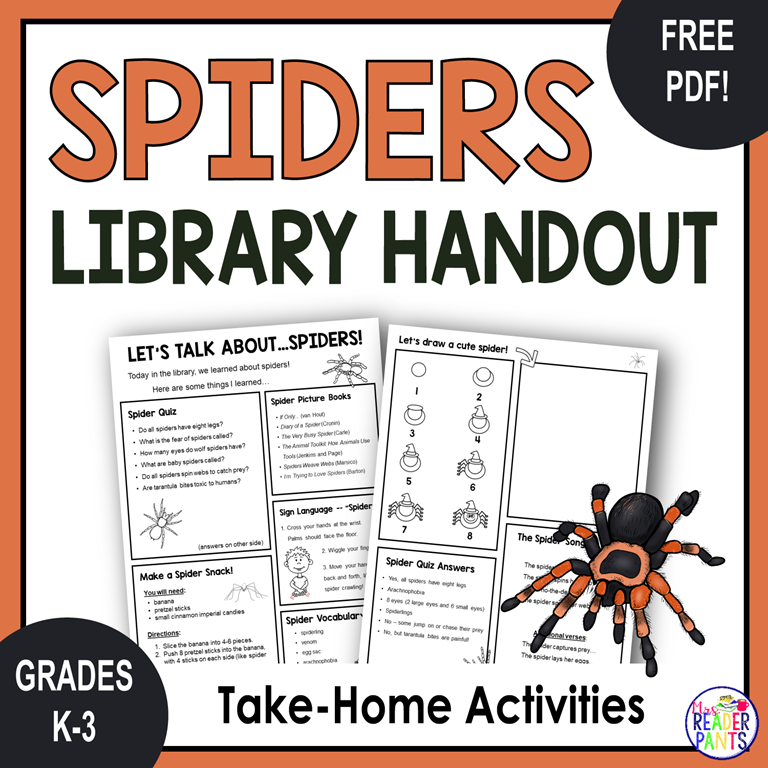
Check out my Spiders Library Handout! It’s perfect for after checkout or a Spiders Storytime lesson. It has fun facts, how to draw a spider, picture book recommendations, sign language, spider vocabulary, and more!
Click here to download my free Spiders Library Handout from TPT!