Earth Day is one of my favorite days in the library! These 7 Earth Day picture pooks and activities will get your students excited to learn about endangered animals and why they need our help.
No matter their age, students really get into Earth Day activities and concepts like plastic pollution, water conservation, planting trees, and endangered animals. I love that they get so passionate about the state of our earth and what we can do to help keep it beautiful and healthy.
Today is Day Two of my three-day blog mini-series of Earth Day Activities.
Yesterday, I shared ideas for middle school library lessons about endangered animals. Today’s ideas focus on great picture book lessons about endangered animals. Tomorrow, I will focus on novels about endangered animals. I either have taught or would teach these lessons with students in Grades 2-7. I think they could also be adapted for younger students as well.
EARTH DAY PICTURE BOOKS #1: Almost Gone BY STEVE JENKINS

Almost Gone simply and colorfully profiles 28 currently endangered and extinct animals.
It was published in 2006, so it would be interesting for students to research the current status of these animals (Spoiler alert: not all have made it to 2026).
Each animal includes a colorful illustration and short description of the animal including: location, estimated number remaining, size, habitat, and reasons for its inclusion on the endangered or extinct list.
Each animal includes a colorful illustration and short description of the animal including: location, estimated number remaining, size, habitat, and reasons for its inclusion on the endangered or extinct list.
Almost Gone is too lengthy to read aloud the entire book out loud. For read-alouds, I really like: Yangtze River Dolphin, California Condor, Miami Blue Butterfly, Golden Lion Tamarin, Giant Stick Insect, and Coelacanth.
It doesn’t really matter which animals you pick, but I do recommend you vary the kind of animals just for some variety. You can read the animal profiles in any order; they still make sense when read in isolation.
Pair Almost Gone with a video about endangered animals. The video linked below profiles 22 of the rarest animals on earth. Number 14 is the Yangtze Softshell Turtle. The video mentions that out of only three Yangtze softshell turtles in existence, two are in a zoo in Suzhou, China (where I used to live!).
Sadly, in 2019, Suzhou Zoo’s female turtle – the last known female of this species – died after an artificial insemination procedure. As of April 2026, the male turtle at Suzhou Zoo is still alive, but without a female, the species will likely become extinct in our lifetime.

EARTH DAY PICTURE BOOKS #2: Don’t Let Them Disappear by Chelsea Clinton

Don’t Let Them Disappear is similar to Almost Gone listed above in that it profiles twelve commonly-known endangered animals.
Each animal is accompanied by a full-color illustration and a description of the animal’s habitat, daily activities, diet, and reasons it is endangered. Each animal profile is followed by the title refrain, “Don’t let them disappear.”
This one is a bit shorter to read-aloud than Almost Gone, but depending on the class, I still might not read the entire book aloud from cover-to-cover. Instead, I would show students the book and read select profiles to start a greater discussion about endangered animals.
Grade levels: This one is for younger students in PreK-Grade 3. It’s also a great choice for older ELL students since it uses common animal names-tiger, whale, rhino, panda–rather than more obscure species or technical species names.

EARTH DAY PICTURE BOOKS #3: Ivan by Katherine Applegate

If you want to tell the true story of Ivan the gorilla, but you prefer a picture book format (or The One and Only Ivan is checked out), this one is great!
It begins with Ivan’s life as a young mountain gorilla in the Democratic Republic of the Congo and takes readers from his capture to a concrete “domain” in a suburban mall zoo.
I generally save this story for a read-aloud of The One and Only Ivan, so for the picture book, I recommend PreK-Grade 2. I have, however, used this for middle school Grade 6 and ELLs. It’s great if your copy of Ivan is checked out, which is sometimes is.
I love showing students this video of a troop (because they’re called troops) of curious mountain gorillas touching a photographer. I love the HUGE silverback that just sits back and watches it all. The photographer has great composure, even when the silverback came in for a closer look.
I showed this video to an eighth grade class yesterday when I did a read-aloud from The One and Only Ivan. At one point during the three-minute video, I looked around the room to see many students smiling as they watched the cute gorillas.
IVAN’S INTERESTING HISTORY
This 15-minute video was created by Zoo Atlanta to publicize Ivan’s history. It’s super-interesting, humorous, and sad all at the same time. I love the story about the burlap bags around 8 minutes in. Sadly, we can’t always see the photos she’s referring to in the presentation because the photos are proprietary. I wish we could have seen the sombrero photos!
EARTH DAY PICTURE BOOKS #4: OWEN AND MZEE


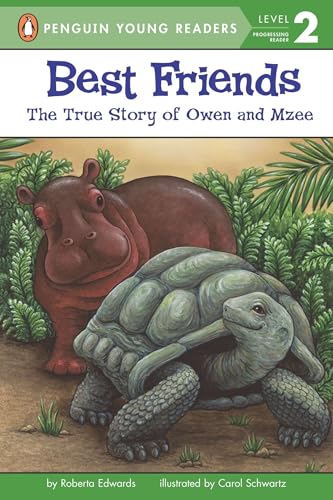
This is such a sweet story to tell! In the aftermath of the December 26, 2004 Indonesian tsunami, a baby hippo washed up near the coastal village of Malinda, Kenya.
Villagers who found the hippo were surprised to find him alive and worked for hours to free him from the coral reef on which the hippo was stranded. Ultimately, the hippo – they called him Owen – was taken to a Kenyan wildlife sanctuary called Haller Park.

What was even more shocking was that Mzee allowed Owen to follow him and snuggle up to him!
There is truly SO MUCH you can do by pairing these two books! It’s a fascinating story of friendship and how it saved this baby hippo’s life after he lost his mother and his pod.
According to this book, Owen might have died if it weren’t for Mzee’s friendship. Mzee taught Owen–who was still nursing when he lost his mother–how to eat grass and leaves. Young Owen also hid behind Mzee when he was frightened and snuggled with Mzee at night.
Recommended for: With younger students up to Grade 2 or 3, I read the picture book A Mama for Owen and just show the photographs of this book.
For older students, I have used this up to seventh grade. This book is too long to read-aloud, so I usually just read the first few pages, starting at the beginning (“When Owen was a baby…”) and ending a few pages later at the end of the paragraph that begins with “News of this astonishing…” My book does not include page numbers, but this totals the first three full-page spreads and the left-side of the fourth full-page spread. Be sure to show the pictures!
Possible activity: Have students research where Owen and Mzee are today. Are they still in Kenya? Are they still friends? (Spoiler alert: As of April 2019, both are still at Haller Park, but they are no longer in the same enclosure because Owen is too big and could hurt Mzee. Owen now lives with a pod of other hippos at the park.)
VIDEO MONTAGE OF OWEN & MZEE PHOTOS
I have two videos of Owen & Mzee’s story below. The first, embedded YouTube video shows multiple still shots of Owen & Mzee. There is no narration, but there some nice classical music in the background if you want audio. This video is less than three minutes and is great to show after storytime or during checkout.
This second video starts with Owen’s arrival at Haller Park. He is still in the back of a truck with nets over him, and he is clearly terrified. At around 1:10, Owen’s head gets free, and he starts furiously biting at the men. Show this to students to emphasize just how difficult it was for the workers to help Owen.
The entire video is nearly 30 minutes, but the opening scene is only about 4 minutes. There are also some cute scenes from minutes 5-8 that show Owen’s first days with Mzee.
EARTH DAY PICTURE BOOKS #5: Saving Fiona by Thane Maynard

Having a bad day? Pull out Saving Fiona and just try not to smile at all that cuteness. No one can resist that adorable hippo sass on the front cover. No one!
Fiona is the first premature baby hippo born in captivity and raised by humans. She was born in January 2017 at the Cincinnati Zoo, two months early and severely underweight.
Fiona’s future was uncertain, but thanks to a large team of caregivers, Fiona defied the odds and improved every day.
This book contains some of the cutest photos of hippos I’ve ever seen! The author, Thane Maynard, is the Director of Cincinnati Zoo & Botanical Garden. He also appears in Fiona’s first video, which is certain to evoke plenty of “awwws” from your students!
I read this book to a sixth grade class this week, and it was a hit! After we read, a group of students was standing at a table looking at the photos together. And that me go “awwww!”
VIDEO FROM FIONA’S YOUTUBE CHANNEL FROM THE CINCINNATI ZOO:
EARTH DAY PICTURE BOOKS #6: I’m a Manatee by John Lithgow

I discovered this adorable book many years ago when I was an elementary librarian. I love John Lithgow, and I’ve memorized parts of the song from the accompanying CD (yes, I’m singing it in my head right now).
I do not recommend reading this one aloud. Instead, play the CD as you turn the pages. This book and song will be an instant favorite with your elementary students!
What’s also great about I’m a Manatee are the illustrations that show reasons why the manatee needs our help. Illustrations show the manatee swimming among garbage in the water. There’s boats speeding through the river where the manatees swim.
After the read-aloud, I go back and show students these illustrations and talk about why manatees are endangered. I then show real-life photos of manatees from nonfiction books. Many nonfiction books–even at the elementary level–contain photos of manatee injuries and scars from collisions with speedboat propellers.
BOATING TIPS TO KEEP MANATEES SAFE
Okay, so most elementary students are not driving boats, and most of them do not live in areas with manatees. But this one-minute video is great to show students how easy it is for manatees to be injured by passing boats. And as an added bonus, the video narrator also mentions disposing of trash properly so manatees aren’t injured by it.
EARTH DAY PICTURE BOOKS #7: The Black Mambas by Kelly Crull

The Black Mambas is a bit of a sleeper picture book that released in 2025. I wish more librarians knew about this unique book!
It’s got lots of real photos of The Black Mambas, an all-female anti-poaching group in South Africa. Together, they track endangered animals to keep them safe from poachers, illness, and injury.
The book includes lots of interactive elements, such as recognizing animal footprints, finding five poacher snares in a photo, finding all 20 Black Mamba members in the photos, how to recognize a poacher camp, and more.
The video below features the Black Mambas as they show Bindi how they find wire snares in the bush. Kleenex alert! This is well-worth watching all 10 minutes, but there may not be a dry eye once it’s over. Don’t worry, it ends on a beautiful and hopeful note.
Want to extend this book? I’ve got a Library Lesson for The Black Mambas picture book!